` Farming Concrete

Stories and Quotes »

[23 Jan 2012 | No Comment | ]

While we do our winter number crunching, Farming Concrete Trainer Beryl Benbow has offered up stories, photos, and histories from her trainings in NYRP gardens this past summer. Thanks Beryl! These photos make us nostalgic for last summer and excited for 2012.

Reposted with permission from http://janebaileymg.com/farming-concrete/. All photos are by Beryl Benbow.

My first demo was at Gil Hodges / Carroll St. Garden; where I discovered a family of parrots in the Mulberry tree. Here are some photos from the garden.


Created with Admarket’s flickrSLiDR.


Jane Bailey MG & Cedar Tree Gardens

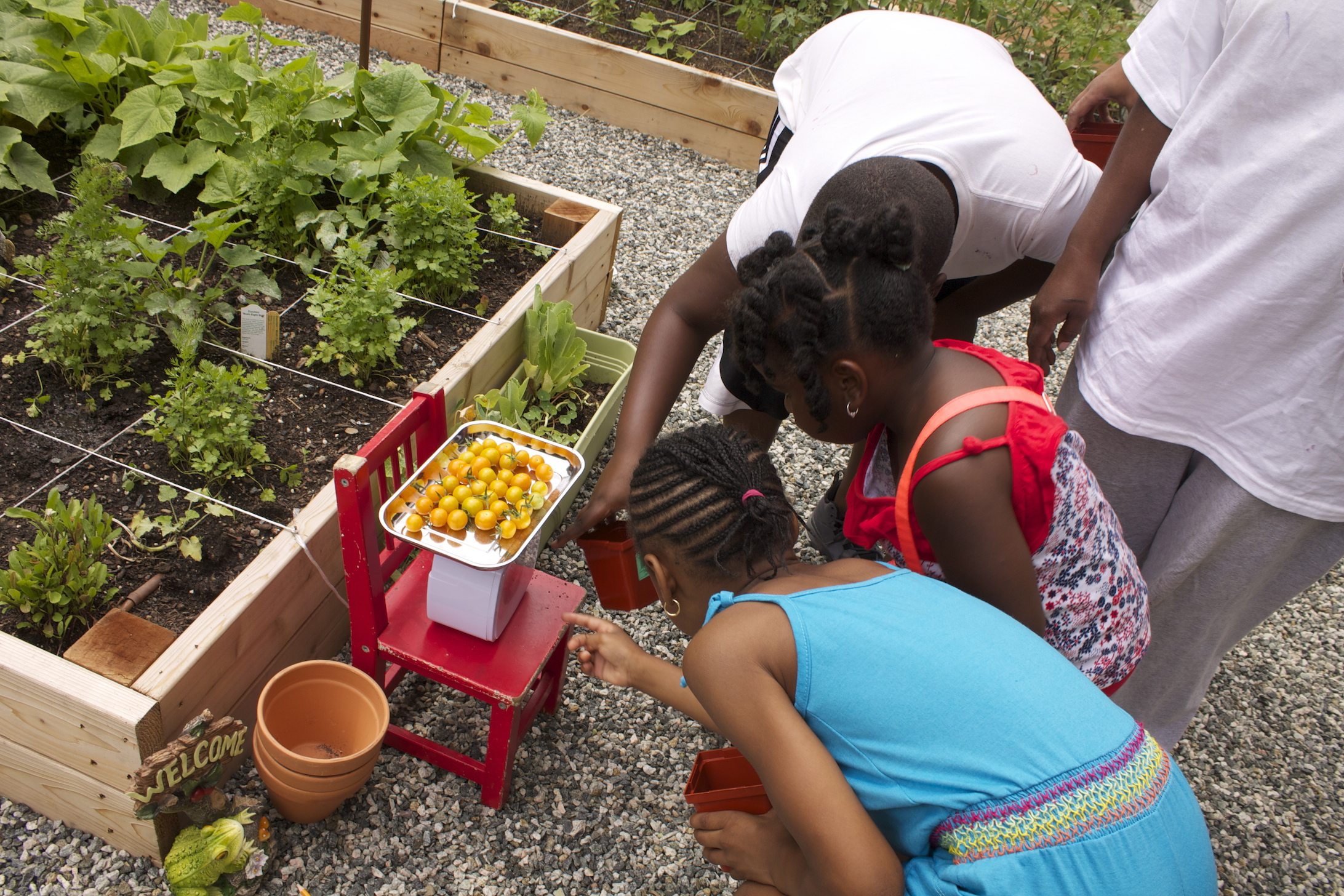
Saturday, July 2nd, 2011 – I explained the farmer’s concrete program and how to weigh the veggies & fruit that gardener’s from my own gardens, Jane Bailey MG and Green Thumb’s, Cedar Tree.

McLeod

Saturday, July 9th, 2001 – Lisa and I visited two NYRP gardens in Brooklyn to demonstrate how to weigh their produce from their gardens. The first garden was on Liberty Ave and Powell. The garden was beautiful and had it’s own flavor with a gazebo covered in wisteria, wonderful seats designed somewhat like  the shape of a canoe with individual bbq  pits.

Landscape architect Lee Weintraub was commissioned by NYRP to partner with the community and Goldman Sachs to enhance this beautiful space. Design features include gravel paths, vegetable and ornamental planting beds, a wisteria-covered gazebo in the garden’s center and an area in the back for grills and tables for food preparation and family-style dining. In addition, NYRP planted many beautiful trees and shrubs, including dogwoods that bloom in the spring, junipers that keep the garden green in winter and a grove of graceful river birch that accentuate the garden’s frontage. In September 2007, community members, NYRP staff and representatives of Goldman Sachs celebrated the restored garden’s opening with a neighborhood barbeque and ribbon-cutting ceremony.

The Heckscher Foundation Children’s Garden

The Heckscher Foundation Children’s Garden is the other garden Lisa and I visited on Saturday. From the NYRP site: In 2006, the Heckscher Foundation for Children provided New York Restoration Project (NYRP) with a $300,000 grant to transform the site from a weathered and worn community space into a vibrant, outdoor classroom and learning experience. The grant also provided essential funding to support the garden’s dedicated and multi-cultural group of neighborhood gardeners.

At the back of the garden, a large shed with a porch allows visiting students from eight neighboring schools and members of a local community center to work on-site, alongside their teachers and NYRP educators. In partnership with the Brooklyn Center for the Urban Environment and local New York City schools, NYRP offers a wide variety of educational programs in this green space, including after-school nature tours that explore the garden’s green features and seasonal workshops that instruct schoolchildren on composting, planting, harvesting and cover cropping.

Greene Acres Garden

July 17th I met with a member from the Greene Acres Garden. From the NYRP’s site: Greene Acres is one of NYRP’s largest and busiest Brooklyn sites, the Greene Acres Community Garden encompasses five lots containing numerous ornamental plantings and a wide variety of vegetables – including tomatoes, cucumbers, green beans, peppers and squash – that greatly contribute to the revitalization of the surrounding area.


Maps »

[23 Sep 2011 | No Comment | ]

I was in Denver last week for a few mapping and programming conferences that might be of interest to those following Farming Concrete.

State of the Map 2011

One of these was State of the Map, the annual meetup for the community behind OpenStreetMap (OSM), the collaborative (wiki-esque) map of the world. I’ve been a part of the project for a few years, and much of the philosophy behind Farming Concrete–open data collection and collaboration using the internet–is inspired by OSM and similar projects. Talks ranged from collecting data (eg, using Walking Papers) to outputting this data (eg, into Pretty Maps) to mini, rapid-fire talks on the state of the map in various countries (eg, the UK, Tunisia, Haiti, Georgia, and the Phillipines).

One attendee talked about the Mushroom Development Foundation, an NGO in northeast India that is helping farmers grow mushrooms because they can be grown more densely than most crops and are therefore more valuable than other crops. The speaker roughly detailed a scheme for mapping farms, which are organized in clusters of 80-180 around 10+ central villages. The foundation’s plan was to use the map to ease the difficulty of working with many hundreds of farms, specifically the logistics of getting the required inputs to farmers. Unfortunately, there wasn’t any mention of mapping mushroom yield, but maybe that will happen once the farms are mapped!

My favorite session revolved around a method of research that is often called citizen science. The basis of this method is the democratization of scientific research by including community members and amateur scientists. Speakers included representatives of Public Laboratory and Grassroots Jerusalem, and Muki Haklay. Public Laboratory has been doing some awesome work with hardware and software to make it easier for people to collect many kinds of data. In the context of State of the Map their focus was on cheaply creating aerial photographic maps using kites and balloons.

Gowanus from above via Public Laboratory

Gowanus from above via Public Laboratory

This technique has been used perhaps most famously to map the spread of oil in the Gulf of Mexico during and after the Deepwater Horizon catastrophe. Similarly, on the ground, Grassroots Jerusalem has been mapping Jerusalem in a collaborative and inclusive way.

From Public Laboratory's Forum

Mr. Haklay’s talk was a critique of citizen science that is summarized by Public Laboratory above: “much of so-called citizen science treats people like mere data points.” At what point are researchers using so-called citizen scientists and at what point are the citizen scientists driving the research? To what degree are the citizen scientists taking part in the definition of the problem being researched, the data collection, and the analysis of the data? Surely all citizen science projects vary by degrees of inclusiveness for each of these dimensions, so Muki introduced the term extreme citizen science to denote those projects which strongly include non-scientists in all three dimensions. I’m not a big fan of adding “extreme” to anything, but I do find these levels useful:


Levels of Citizen Science

Levels of Citizen Science, Muki Haklay

Where does Farming Concrete land on this scale? What could we be doing better?

When it comes to data analysis I think we have done a good job of giving gardens and gardeners the data that they recorded. We do not accept any data that we do not return to gardeners. This way gardeners can look at how their numbers line up with other gardeners, both within their gardens and with gardens citywide. Gardeners can then use this data when defending their land, fundraising, or for whatever reason they see fit.

The problem definition part of the research seems less favorable since Farming Concrete was started solely to estimate the amount of food grown in NYC’s community gardens. However, the problem has evolved through conversations with other gardeners since the project’s inception. This year, after a number of passionate school gardeners contacted us we decided to include school gardens in our survey. Last year and this, some gardeners weighed things other than plant yield such as honey and compost. While we don’t have enough data from other gardens to give these gardeners a citywide context, we’re ecstatic that providing scales and a technical structure for recording weights has led to people weighing what’s important to them.

Finally, we’re utterly dependent on gardeners collecting the data that we use in our analysis. We know that it can range from tedious to impossible sometimes, but from our perspective asking gardeners to weigh their own produce if they want to is far less invasive and much more sensible than sending teams of researchers to gardens to do this.

Otherwise, I had many fun conversations and learned so much about open source map technology that should help Farming Concrete, but I won’t bother you with that yet.

Stories and Quotes »

[22 Sep 2011 | No Comment | ]

Open Space Institute, our fiscal sponsor, has included us in this month’s newsletter alongside a few other great food & farming organizations. Check out the article here to read about us, Brooklyn Food Coalition, and the Rondout Valley Growers Association.

From the preservation of huge swaths of farmland in the Hudson Valley and the Catskills to the cooperative nurturing of quarter-acre community gardens in New York City, the Open Space Institute believes in the idea that people and land support one another. As we protect our open spaces, they provide for us many times in return.

Map of Rondout Valley Growers Farmers (reposted with permission from OSI)

Stories and Quotes »

[22 Aug 2011 | No Comment | ]


A big thank you to Carmen and Abe from the Volky Flower Garden in The Bronx for sending us pictures of a great looking harvest! We can’t wait to see what else you guys have growing.


Send us pictures of your harvest at gardens@farmingconcrete.org and we will post them on our blog for every one to see!


Stories and Quotes »

[6 Jul 2011 | No Comment | ]

Part of the CS 112 garden

Farming Concrete was one of the lucky groups invited to participate in the first annual environmental fair at C.S. 112 in the Bronx! We had a great time weighing fruits with the students as well as seeing what other organizations are up to.

Learning about bees from our friend Roger!

Learning about energy!

Making seed bombs

You guessed it...those are solar oven s'mors!!!!